Epilepsy
- BOOK ONLINE
+ Medical Marijuana CardWE MAKE IT
CLEAR
- BOOK ONLINE
+ Medical Marijuana CardWE MAKE IT
CLEAR
HOW TO GET
A Texas Medical
Marijuana Card

If you are wondering how to…
Get a Texas Low-THC Prescription.
Texas uses a prescription registry, not a card.
Texas has no medical marijuana card to apply for. Under the Texas Compassionate Use Program, a physician registered with the Department of Public Safety enters your low-THC cannabis prescription in the state registry, called CURT. This page explains who qualifies, what the law allows and what the state charges.
Patients do not enroll in anything: DPS says the statute requires no patient registration and no state fee. Your costs are the physician visit and the products you buy. A physician prescribes only after confirming a condition listed in Texas law and registering as your prescriber in CURT.
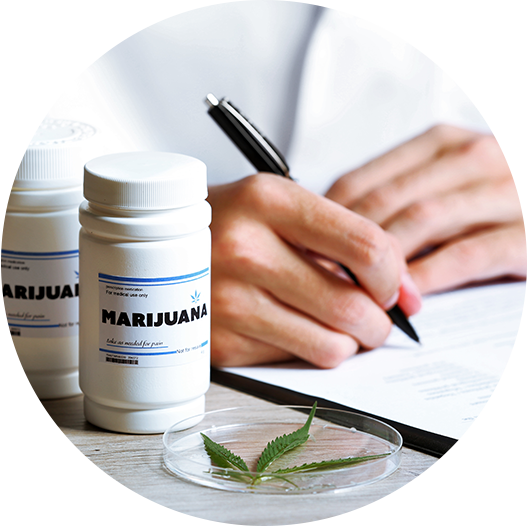
The first step to getting a Texas low-THC prescription is to…
Get an evaluation by a marijuana doctor registered in CURT, who decides whether to prescribe.
If you qualify, your physician registers as your prescriber and enters the prescription in CURT; there is no state card and nothing for you to file. You can then legally buy, possess and use low-THC cannabis from a licensed dispensing organization. Your physician also keeps a written treatment plan that sets your dose and how you take it.

ONLY A CURT-REGISTERED
TEXAS DOCTOR MAY PRESCRIBE
To get a Texas low-THC cannabis prescription, you must first be evaluated by a Texas-licensed physician who qualifies under state law and is registered in CURT. If you are not a permanent Texas resident, Texas law does not let you join the program.

TEXAS COMPASSIONATE USE
REGISTRY (CURT)
There is no registry application for patients. Your physician enters the prescription in the Compassionate Use Registry of Texas, and dispensing organizations look it up there. There is nothing to expedite and no state approval to wait for.

NO TEXAS
MARIJUANA CARD NEEDED
Patients with a prescription in CURT can legally obtain low-THC cannabis from a DPS-licensed dispensing organization, by pickup or delivery. Patients may possess and use it as prescribed but may not grow cannabis. Texas has no recreational market.
Qualifying Medical Conditions
Seizures
Cancer
Chronic Pain
Multiple sclerosis
Traumatic brain injury
Crohn’s disease
PTSD
Spasticity
Other Conditions Listed In Texas Law Also Qualify For A Low-THC Cannabis Prescription.
See If Your Condition Is On The Texas List
Dr. Green Relief Texas
Marijuana Rules, Explained Plainly
See If Your Condition Is On The Texas List
FAQS
Requirements
Residency & Age Requirements
You must be a permanent resident of Texas. Texas sets no age limit; for a patient under 18, the physician records a legal guardian in CURT, and that guardian may pick up the prescription.
Texas Low-THC Qualifying Conditions
Under Texas Occupations Code chapter 169, patients diagnosed with any of the following conditions may qualify for a low-THC cannabis prescription:
- Post-traumatic stress disorder (PTSD)
- Epilepsy
- Seizure disorders
- Amyotrophic lateral sclerosis (ALS)
- Multiple sclerosis
- Spasticity
- A condition that causes chronic pain
- Parkinson’s disease
- Cancer
- Autism
- Other incurable neurodegenerative diseases named by state rule
- Traumatic brain injury
- Crohn’s disease or other inflammatory bowel disease
- Terminal illness or hospice or palliative care
- A medical condition approved for a research program under Texas law, while you receive treatment in that program
Providing medical documentation
If you have medical documentation of a qualifying condition (such as medical records, prescription bottles, a summary of your office visit, or a doctor’s letter confirming your diagnosis), bring it to your evaluation, because the physician must confirm a condition listed in Texas law.
If you don’t have medical documentation for a qualifying condition, please call or text us at 800-420-8423. We can explain the Texas rules, but a physician may prescribe only for a diagnosed condition listed in Texas law, so ask the doctor who treats that condition for your records.
General
Where do I find a Texas Medical Marijuana Doctor?
If you are a permanent Texas resident looking for a medical marijuana doctor, start with the state’s own list. DPS runs a public physician search in CURT that lists qualified physicians who agree to be published. You can also reach us through the contact form onsite or call 800-420-8423.
What is “low-dose” THC cannabis?
The most distinctive aspect of Texas’s Compassionate Use Program is its restriction on cannabis use to low doses of THC. Since September 1, 2025, Texas law calls cannabis “low-THC” only if each dosage unit holds no more than 10 milligrams of THC.
Texas law covers products made from the plant Cannabis sativa L.; it limits the THC in each dosage unit rather than naming a strain. A Texas prescription lets patients buy low-THC products such as lozenges, gummies and tinctures, plus patches or inhaled vapor when prescribed, but never smokable flower.
Each prescription records the dosage and the means of administration, and dispensing organizations log every amount they dispense in CURT, so use can be tracked.
Under Occupations Code 169.005, the prescribing physician keeps a treatment plan that sets the dosage, the way you take it and the planned length of treatment. The plan also covers how the physician will watch your symptoms and any signs of tolerance or reaction.
What are the restrictions for a medical marijuana purchase/possession?
Texas allows medical use only of low-THC cannabis prescribed through CURT, and it has not decriminalized marijuana possession.
Low-THC cannabis with no more than 10 mg of THC per dosage unit can be prescribed for conditions including epilepsy, autism, cancer, PTSD and chronic pain.
Cannabis above the low-THC limit stays illegal to use, possess, sell, distribute or produce under state law, and a dispensary may not sell a package holding more than 1 gram of THC.
Doctor’s Certification
Can any doctor prescribe low-THC cannabis in Texas?
No. Texas requires the prescribing physician to hold a Texas medical license, be certified in a specialty relevant to your condition, treat that condition as a significant part of practice, and register as your prescriber in CURT.
You can check a physician’s CURT registration in the DPS public physician search, which lists physicians who agreed to be published.
Getting a Prescription
Do I have to wait for a Texas medical marijuana card before using low-THC cannabis?
There is no card to wait for: once a physician registered in CURT finds that you qualify, the physician enters your prescription in the Compassionate Use Registry of Texas. Only then can a patient buy low-THC cannabis from a licensed dispensing organization and use it as prescribed.
What’s the process of renewal?
Only a physician registered in CURT as your prescriber can renew your prescription. Each Texas prescription covers up to a 90-day supply with up to four refills, and your physician must renew it in CURT after that.
What changes should I tell my physician about?
Patients file nothing with the state, so there is no state office to update. Tell your physician if your name, address or contact details change.
If you switch physicians, your old physician must first end the link in CURT.
Only one physician can be your prescriber at a time.
Can a minor get a low-THC cannabis prescription in Texas?
In Texas, minors with qualifying conditions can be prescribed low-THC cannabis by a physician registered in CURT. A minor’s prescription is picked up by the legal guardian recorded in CURT. The physician records that guardian’s name and the last five digits of the guardian’s Social Security number in CURT.
Dispensing organizations check the identification of every patient or legal guardian who picks up a prescription. A minor in Texas needs that guardian to collect the prescription.
How long does it take to get a Texas low-THC prescription?
Texas puts one step between you and a prescription: the physician visit. A physician registered in CURT evaluates you and enters any prescription in the Compassionate Use Registry of Texas, and you can then fill it at any DPS-licensed dispensing organization. There is no state review or waiting period for patients, so timing depends on your physician visit and how fast the dispensing organization fills or delivers the order.
What paperwork do I need for a Texas low-THC prescription?
Texas has no patient application form. Your physician enters the prescription directly in the Compassionate Use Registry of Texas (CURT), and you can then fill it at a licensed dispensing organization.
If you are a permanent Texas resident looking for a medical marijuana card, the step that matters is an evaluation by a physician registered in CURT.
Prescription Entry In CURT
Who qualifies for a low-THC cannabis prescription in Texas?
A Texas physician may prescribe low-THC cannabis for you only if all three of these are true:
- You must be a permanent resident of Texas.
- You must be diagnosed with a qualifying condition.
- A qualified physician must determine that the risk of your medical use of low-THC cannabis is reasonable in light of the potential benefit for you.
If you meet these requirements, a physician may enter a Texas low-THC cannabis prescription for you in CURT.
Is it optional to be registered?
To buy from a dispensing organization, your prescription must be in CURT, but you do not register yourself; DPS says patients do not register in CURT.
Your physician registers as your prescriber and enters the prescription, and any licensed dispensing organization can then fill it.
Why get a low-THC cannabis prescription in Texas?
Texas lets a registered physician prescribe low-THC cannabis only for a listed condition, and only after finding the risk reasonable in light of the potential benefit for you. A Texas low-THC prescription lets permanent residents with qualifying conditions buy low-THC cannabis from a licensed dispensing organization, then possess and use it as prescribed without state marijuana possession charges.
How long does a Texas low-THC prescription last?
Your record stays in CURT, but each prescription covers no more than a 90-day supply plus up to four refills, so your physician must renew it to keep filling it.
When should my Texas prescription be renewed?
Get your prescription renewed before your last refill runs out, so a dispensing organization still has a prescription in CURT to fill.
There are no state fees, only the physician’s visit and the products.
Texas has no card to renew, so plan the renewal as a follow-up with your physician.
Why might a Texas physician decline to prescribe?
Texas has no ID card application, so the state denies nothing. A physician may decline to prescribe if you do not have a qualifying condition. If you have none of the conditions listed in Texas law, the program is not suitable for you.
Patients must be permanent residents of Texas.
Dispensing organizations ask for identification plus your last name, date of birth and the last five digits of your Social Security number.
The physician must certify to DPS that you have a qualifying condition and that the risk of low-THC cannabis is reasonable in light of its potential benefit.
Without a prescription in CURT, a dispensing organization cannot fill an order.
What should I do if a physician declines to prescribe?
If a physician declines to prescribe, ask that physician why; DPS reviews no patient applications.
How will I know my prescription is in CURT?
There is no state approval notice. Your physician decides at the evaluation and enters the prescription in CURT, so ask your physician to confirm the entry; any licensed dispensing organization can then find it there.
Is medical cannabis program participation publicly known?
No. Your participation in the Texas Compassionate Use Program is kept private. In addition, Texas Health and Safety Code 487.054(c) makes the fact that you are listed in CURT confidential.
Employers, friends and family cannot look you up in CURT; access is limited to DPS, registered physicians, dispensing organizations and law enforcement verifying a prescription.
State Program
Does Texas have a medical marijuana card program?
Not as a card program, but yes, Texans have access to low-THC medical cannabis through the Texas Compassionate Use Program. DPS runs the program, keeps the registry, CURT, and licenses the dispensing organizations. In 2015, Texas lawmakers enacted the Texas Compassionate Use Act, making it legal to use cannabis with low THC for those with specific medical conditions. Additional qualifying medical conditions were added to the law in 2019, 2021 and 2025, thereby expanding eligibility.
Which diseases are designated as incurable neurodegenerative diseases in Texas?
Texas leaves this list to a rule: the HHSC executive commissioner designates these diseases in consultation with the National Institutes of Health (Occupations Code 169.001(2)). DSHS explains the rule that designates them, 25 TAC 1.61, on its low-THC cannabis medical use page.
Who is the regulating office or agency for the program?
The Texas Department of Public Safety (DPS) regulates the program and operates CURT, the Compassionate Use Registry of Texas; DSHS keeps the list of incurable neurodegenerative diseases.
Will there be more qualifying conditions to be added to the program?
Possibly, since lawmakers have widened the list three times. At first, the Texas Compassionate Use Program allowed low-THC cannabis only for certain intractable epilepsy disorders. In 2019, Texas expanded the program to include patients with multiple sclerosis, terminal cancer, and other incurable neurodegenerative diseases. And in 2021, lawmakers again expanded the program to include other conditions. In 2025, HB 46 added chronic pain, traumatic brain injury, Crohn’s disease and other inflammatory bowel disease, and terminal illness or hospice care, and physicians can now ask DSHS to report other conditions to the Legislature, with supporting medical evidence.
Caregivers
Can a legal representative purchase medical cannabis?
Texas lets a patient’s legal guardian pick up a prescription; the physician records the guardian’s name and the last five digits of the guardian’s Social Security number in CURT. Texas law makes no provision for other caregivers or representatives.
Laws
Can you have a prescription from another state filled in Texas?
No.
Texas Health and Safety Code Section 487.107 lets a dispensing organization fill only a prescription entered in the Texas compassionate-use registry, so a prescription written in another state cannot be filled here. The entry must come from a Texas-licensed physician who takes part in the Compassionate Use Program.
What protections will patients and legal guardians have from criminal prosecution?
Texas law gives patients and their legal guardians one specific protection. Under Texas Health and Safety Code Section 481.111(e)(1), the marijuana and drug paraphernalia possession offenses in Chapter 481 do not apply to a patient for whom low-THC cannabis is prescribed under Chapter 169 of the Occupations Code, or to that patient’s legal guardian. The exemption applies only while that person possesses low-THC cannabis obtained under a valid prescription from a licensed dispensing organization.
That exemption covers low-THC cannabis only; possessing other marijuana is still a crime.
How is medical cannabis legal in the State?
The Texas Compassionate Use Act, passed in 2015, was the first step in bringing low-THC cannabis to Texas patients.
The law allowed patients with intractable epilepsy to use low-THC cannabis products.
In 2019 the law added conditions such as terminal cancer and autism, in 2021 it added all cancers and PTSD, and in 2025 HB 46 added chronic pain and traumatic brain injury.
HB 46 also requires DPS to license 15 dispensing organizations, up from three.
Can I use low-THC cannabis in public with a Texas prescription?
Texas law lists no places where patients may use low-THC cannabis, so use it privately, only as prescribed, and never smoke it.
Should my employer know I participate in the Compassionate Use Registry of Texas?
Your employer cannot look you up in CURT, so whether to tell them is your decision.
Texas law does decide who can see your registry record.
Under Texas Health and Safety Code 487.054 your CURT record is confidential: only DPS, registered physicians and dispensing organizations may access it, law enforcement may check it to verify a prescription, and DPS may release it to you or someone you name.
Employers are not on that list, though drug tests and medical records fall under other laws.
Low-THC cannabis prescribed under the Texas Compassionate Use Program is still a controlled substance under federal law. Section 487.054 only limits who may see your registry record; it does not address what an employer may do after a positive drug test, so ask a Texas employment attorney if that matters to you.
Weigh that federal status and any drug-testing policy at your job before you decide whether to tell your employer.
Dispensaries
What would happen if I bought cannabis from a non-licensed MMJ dispensary?
Buying marijuana from an unlicensed seller in Texas can lead to a possession charge, even for a patient with a prescription in CURT.
Possessing 2 ounces or less is a Class B misdemeanor, punishable by up to 180 days in jail, a fine of up to $2,000, or both.
While Occupations Code chapter 169 lets a registered physician prescribe low-THC cannabis to a qualifying patient, the state only allows dispensing organizations to sell it if they’re licensed by the Texas Department of Public Safety. For more than 2 ounces the possession charge is heavier: still a misdemeanor up to 4 ounces, and a felony above that.
The patient exemption in Health and Safety Code 481.111(e)(1) covers only low-THC cannabis from a licensed dispensing organization, so an unlicensed purchase gets no protection.
DPS lists the licensed dispensing organizations on its website, and they deliver prescriptions.
How much medical marijuana can I purchase at once?
Your physician sets the dose, but Texas caps each prescription at a 90-day supply, each dosage unit at 10 mg of THC and each package at 1 gram of THC.
Should I purchase the entire amount recommended by the marijuana doctor?
Not necessarily: each purchase is measured against the prescription your physician entered in CURT, not against a general recommendation.
Your physician’s entry records the dosage, the means of administration and the total amount needed to fill the prescription, so ask before buying less than that amount.
Dispensing organizations also deliver, so a long drive does not have to change how much you buy.
If cost is a concern, talk with your physician about the prescribed amount before it is entered in CURT.
You cannot buy more than your prescription allows, because a dispensing organization fills only what your physician entered in CURT.
Each fill is recorded in CURT with the form, quantity, date and time, so keep to the prescription as entered.
Reciprocity
Are out-of-state patients recognized in Texas?
No. Under Texas Health and Safety Code Section 487.107, a dispensing organization may fill a low-THC cannabis prescription only after verifying it in the compassionate-use registry, and under Occupations Code chapter 169 only the physician registered in that registry as the patient’s prescriber can issue it.
Furthermore, for a prescription to qualify, the recipient must be a permanent Texas resident listed on the Compassionate Use Registry.
Do other states recognize a Texas low-THC cannabis prescription?
Texas issues no card for other states to recognize; each state sets its own visitor rules, and Texas accepts no out-of-state prescriptions.
Texas Guides By City
Appointments
Texas telehealth evaluations are open.
Dr. Green Relief offers Texas telehealth evaluations by video at $159; use the Book Online button at the top of this page to book your visit.
"*" indicates required fields
About
Dr. Green Relief is the patient’s choice for Marijuana Doctors all over the U.S. We make getting your Medical Marijuana Card easy.

Dr. Green Relief
Recent Posts
Recent Posts
- Marijuana and Antidepressants: What Patients Should Know
- Marijuana Tolerance Break: What It Is and What to Expect
- How to Read a Cannabis Product Label: THC, CBD, Dosage & Safety Explained
- CBD vs THC: What’s the Difference and Which One Is Right for You?
- CBD and Autism: Potential Benefits, Risks, and Limitations